

The criminal trial: a terrible, unrepeatable event
The disenfranchisement of the jury and its consequences

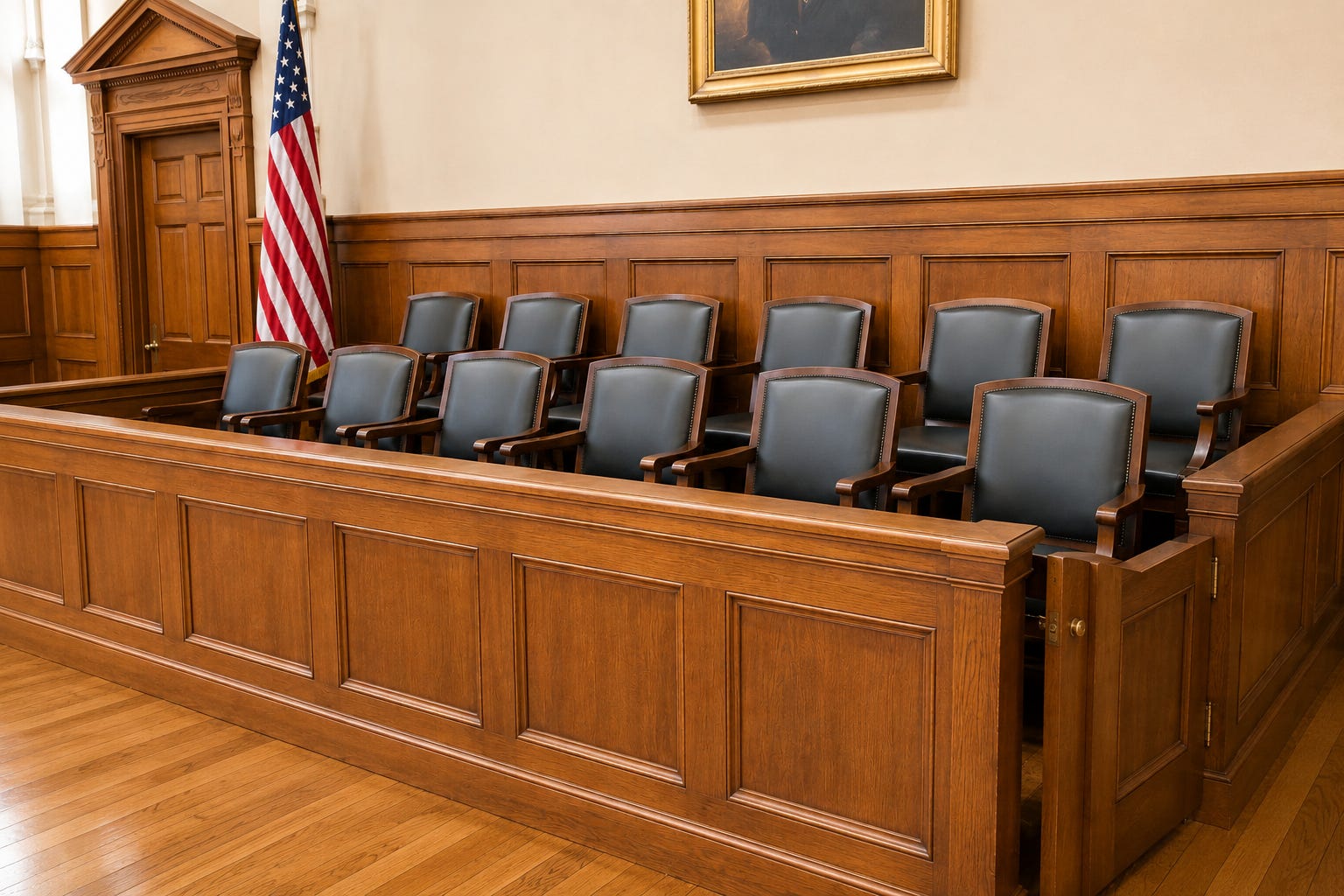
Our fortress against government tyranny has been weakened
The modern justice system mutes the power of the jury, turning citizen lions into tame mice. Jurors were intended by the founders to be a fortress, the last stand, against the tyranny of government power.
To be fair, many rules of evidence and procedures were created by well-meaning people to reduce bias and enforce order. Rules and procedures are important. Jurors, however, are often made to feel small amidst all the coded language and procedures. They are treated as outsiders in the process. They are not.
According to the founders, twelve ordinary citizens sitting in a jury box should be seen and act as the ultimate check on state power. But in practice, the legal guild has built a system that weakens the jury system. (For more on the topic of the legal appartus as guardians see my article, "Secret handshakes and speaking in code").
A terrible, unrepeatable event
G.K. Chesterton, the great writer and social critic, wrote a 1909 essay on why the jury is irreplaceable:
“Our civilization has decided... that determining the guilt or innocence of men is a thing too important to be trusted to trained experts... if I were on trial for my life I should not like to be tried by a judge, who would be accustomed to the rule, and would see every case as a variation on a pattern; I should like to be tried by a jury, who would see it as a terrible, unrepeatable event” (G.K. Chesterton, “Twelve Men,” Tremendous Trifles, 1909).
While dedicated defense attorneys fight fiercely for their clients and feel the weight of every verdict, the system itself - the court calendar, the docket, the prosecution apparatus - treats a trial as routine business.
Meanwhile, the human being sitting at the defense table is forced to remain silent (unless he testifies), watching specialists navigating a complex system with its own language, approaching the bench to chat about him but without him or the jury, all to decide his fate. For him, it is not routine. It is a terrible, unrepeatable event where his natural right to liberty hangs in the balance.
The Founders recognized that institutional power naturally becomes desensitized to the machinery it operates. That is precisely why they insisted on the citizen jury.
The Constitutional firewall
The Founders did not create the jury to be an arm of the court; they built it to be the last stand against the ever-present threat of tyranny from all three branches of the U.S. government: judiciary, legislative, and executive. Some have even referred to the jury as the “fourth branch of government.”
Because police, prosecutors, and judges wield the immense power of the state, the jury was designed to be the final check on power through which government authority must pass. Once the jury is weakened, the power of police, prosecutors, and judges gains intensity, sometimes in response to public opinion, but other times because human nature craves power.
John Adams wrote that trial by jury and representative government are “the heart and lungs of liberty... without them we have no other fortification against being ridden like horses.” Thomas Jefferson called it “the only anchor ever yet imagined by man, by which a government can be held to the principles of its constitution” (John Adams, Novanglus Essays No. VII, 1775).
Crucially, early American law recognized the jury’s absolute power to acquit. The verdict of Not Guilty was designed to be inviolable. The state cannot appeal an acquittal. The jury’s word was final. This gives citizens immense last-resort power in matters of crime and punishment in a Republic.
Carefully managed decision-making
Fast forward to a modern courtroom. The system often treats jurors like children who must be managed. Jurors are routinely kept in the dark about potential sentences, shielded from hearing arguments related to motions, and are warned to never seek outside context.
There are justifications for these rules. However, if I am deciding whether to remove the natural right to liberty of an accused individual and acting as a check on state power, I want to hear more. I want to hear enough to ascertain the motives and character of the state’s agents who are seeking to remove an individual’s liberty.
Then comes the final maneuver: the jury instructions.
Once both sides of the case have “rested,” the judge will instruct the jury with a lengthy list of instructions filled with hyper-technical legalese, points that have been pre-argued (in secret) by both the prosecution and the defense. (Yes, I would like to hear these arguments, as well). In case the instructions were not sufficiently driven home by the judge in the courtroom, jurors are given the detailed instructions to read again once they begin deliberation.
The message to jurors, intended or not, is written between the lines: We control you. Follow our instructions precisely. What is the effect? Jurors are disempowered. They cannot fully discern and execute the vital function of defending liberty against government power because they have been reduced to hearing a carefully orchestrated and edited event to decide innocence or guilt. Jurors are forced to ask, “Did the state satisfy formula X?” instead of asking, “Is it right, just, and do we have enough moral certainty to strip this human being of his liberty?” and “Is the state abusing its authority?”
By turning human judgment of moral certainty into a confusing legal compliance test, the system has neutered the citizen fortress our system of government needs. Confronted with the sheer power displayed by the state in the courtroom (paying deference to the judge, armed deputies, roll call, strict instructions) jurors frequently default to a position of deference to the authority of the state.
The judical and legal apparatus have largely transferred power to themselves. Jurors have been reduced to a compliant, even manipulated arm of state bureaucracy.
When the fundamental laws and procedures of a republic feel foreign to citizen jurors, and jurors feel powerless in the presence of state power, the system ceases to function as intended. Consequently, the last division defending the fortress no longer knows to stand watch, and justice gradually crumbles from within.
About the author
J. Steven Bromwich is a criminal defense investigator and ethicist, with advanced training in history and diplomatic studies. He writes about crime, power, and ethics to help readers navigate modern problems through historical perspective and first principles.