
What do healthcare and America’s first censored newspaper have in common?
The history of healthcare is a high stakes human drama

By J. Steven Bromwich
Healthcare: saints and sinners
The soul of healthcare is service. It includes the stories of heroes and villains. These stories are inspiring, infuriating, thought-provoking, humbling, and even life-changing.
The stories that comprise this drama, both past and present, need to be told and recounted from the perspective of what it means to care for the sick, dying, disabled, and otherwise vulnerable human beings. Every one of us will encounter medicine. Hopefully, we are cared for by the heroes and saints, those who embrace the high calling of serving those needing care.
Why start with an article about silencing the freedom of speech?
Imagine you are a doctor, a researcher, or other healthcare professional. You have just discovered a new way to prevent or treat an otherwise intractable disease or infection. Your discovery, although effective, differs from current medical norms. This is amazing news and will be welcomed with enthusiasm by your professional colleagues, right? Maybe not.
What if your discovery threatened reputations, an existing financial pipeline, even the careers of your professional colleagues? You might encounter resistance. It is possible you would be silenced by not having your papers published, not receiving grants, perhaps being fired and blackballed from your profession. Even worse, your new discovery, a treatment that could save lives, may never reach those in need.
Don’t believe it? This has happened repeatedly throughout the history of medicine. Silencing, cancelling, name-calling, skewing algorithms happen today, as well. This kind of darkness, one that would crush lifesaving treatment in favor of personal gain, is a symptom of the darker side of human nature.
I named this publication “1690 Media” because without the freedom to speak and share our ideas, including the freedom to disagree with others, all other freedoms are threatened. In healthcare, the lack of freedom to share research results, debate the research of others, have open discussions, is dangerous. We all suffer. 1690 Media is named for the year Publick Occurrences was both published and shut down.
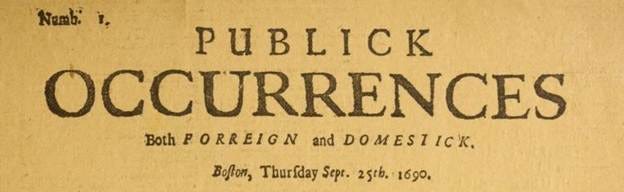
The first page of Publick Occurrences. Public domain. https://archive.org/details/publickoccurrenc1169unse/mode/2up
First American newspaper censored, cancelled, and destroyed
Publick Occurrences Both Forreign and Domestick, the first multi-page colonial publication in 1690 Massachusetts was cancelled by the government. Colonial authorities (the British Crown) disapproved of content that criticized the government, the British military, and tattled on royals. It only took colonial authorities four days to put an end to the newspaper.
Benjamin Harris first published Publick Occurrences on September 25, 1690, and was officially banned and shuttered on September 29, 1690. Authorities ordered the destruction of every copy. None survive except one currently located at the British Library.
This did not stop Harris, a publisher and tireless supporter of free expression and free press. He forged ahead despite official government opposition. In addition to coffee house gatherings, Harris went on to print and circulate content for the public in the form of discreet fliers. He did not, however, attempt to publish another newspaper in the colonies.
Is it “free” if it is censored or needs government approval?
In 1704 the Boston News-Letter became the first continuously published newspaper, but at a price. John Campbell, its publisher, obtained government approval. The front page prominently displayed, “Published by Authority.”
If a media outlet needs government approval to publish content with its materials passing through a censor, is it free? Are we free people if information about public affairs has been scrubbed by a government bureaucrat before we see it, meaning vital information is missing? Do government authorities have the right to terminate a publication’s existence (or cancel a writer) even if it publishes unsubstantiated rumors, inaccurate content, or content that opposes official government positions? What if government uses proxies, like tech companies, to limit speech?
The First Amendment of the United States Constitution, ratified in 1791, resoundingly says, “no” to all these questions. The First Amendment exists to protect free speech from government oversight and threat.
“Congress shall make no law respecting an establishment of religion, or prohibiting the free exercise thereof; or abridging the freedom of speech, or of the press; or the right of the people peaceably to assemble, and to petition the Government for a redress of grievances.”
About a century after the colonial authorities shut Benjamin Harris’ Publick Occurrences down, the founders put these forty-five words into law intended to protect the right to speak and publish freely without fear of government censorship and other consequences. It is likely the American founders knew of his newspaper and what government authorities did to it.
The need for objectivity and free expression is also true of medical and scientific organizations. This is not only part of the American way of life, but also the scientific method. Neither the government nor media organizations, including tech companies, should silence and censor medical science and debate.
Our Mission
The mission of 1690 Media is to tell both inspiring and disturbing stories of the heroes and villains of healthcare. There are magnificent achievements and monumental failures. There are people who gave up comfort, even their lives, to serve the sick and suffering. There are others who gave up the sick and suffering to serve their own greed.
Subscribe and never miss a new story! A new story will be published every Monday.
For more details on Publick Occurrences Forreign and Domestik see https://www.history.com/articles/first-colonial-american-newspaper-1690
J. Steven Bromwich founded 1690 Media to explore the soul of healthcare. He tells the stories of heroes and villains of historical healthcare, connecting these moral lessons to modern medicine. He is an ethicist, criminal investigator, and RN.