

Policing in early America and its growth
Is the vision of the founders still alive in policing?

Policing today looks quite different than policing in early America. Much like the idea of policing in English Common Law, policing in early America was considering a local civic function, not one of large professional police departments.
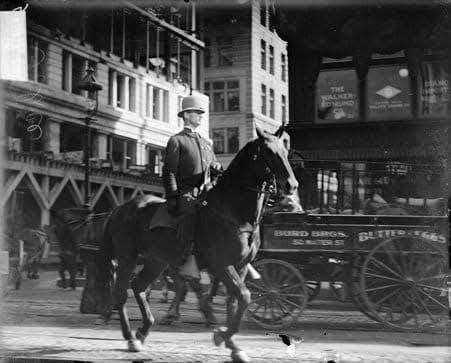
Who watches the watchmen?
Who watches the store? was the concern of the founders. They deeply distrusted Executive power, meaning the power of the executive branch, whether at the national, state, or local level. This was a concern not only because of their direct experience with the British Crown, but also the result of the their extensive understanding of philosophy, morality, and human nature.
Their concern about centralized authority gave birth to the Fourth Amendment of the Constitution, which limits government intrusion into the life of citizens, such as in government searches (of persons and properties).
Keeping it local keeps it accountable (mostly)
The expectation of the founders was to keep law enforcement largely local. They did not trust federal-level police powers. Although these powers have been on the rise in recent decades, most police powers continue to reside at the state and local level.
Local power was to be the norm. It included the Sheriff at the county level, a constable at the town level, the court, and juries, and sometimes night watchmen. The right to a trial of one’s peers and juries kept control of criminal justice and outcomes largely in the hands of local citizens.
An important recurring theme that flows from the vision of the American founding is that no single institution should possess all coercive power. Power was to be fragmented. This was intentional.
Legislatures make laws (which can be challenged and decided in higher courts), courts issue warrants on satisfactory probable cause, juries review facts and determine guilt and innocence, and sheriffs execute orders with the clearance of the court. Moreover, citizens participate in governance, holding authorities accountable.
The rise of massive police forces
The founders’ vision began to unravel in the early 19th century. Rapid urbanization and growing cities brought big challenges to law and order. Immigration, growing cities, labor unrest, riots, general disorder, organized crime, all contributed to making the old model insufficient to maintain public order and safety for citizens.
New York City formed a modern police department in 1844-45. Boston and Philadelphia formed their own in 1854, and Chicago in 1855. Ironically, these police departments were largely modeled after the London Metropolitan Police Department.
Trade-offs
Citizens want to be safe. To accomplish this in concentrated populations, during civil unrest, persistent crime, and disorder, centralized police forces were needed. The old system proved insufficient.
Concentrated power, which tends to be less accountable because of its distance from citizens, is the trade-off. More safety has meant less transparency and accountability in policing, especially in larger cities. Citizens and the press continue to monitor and try to hold the system accountable, but large law enforcement operations are often practically impermeable.
The resulting system and founding questions
Criminal justice today consists of large and powerful systems with many layers. These include law enforcement with well-funded investigators, prosecutors with massive powers, and a system tilted toward assuming reasonable suspicion, probable cause, and guilt. The government side is well-funded. The accused side is not.
The founders would likely ask a key question: what checks exist to control this concentrated power (and money)? Are they effective? Are citizens being protected from centralized government authority? How? Is it enough?
About the author
J. Steven Bromwich is a criminal defense investigator and ethicist, with advanced training in history and diplomatic studies. He writes about crime, power, and ethics to help readers navigate modern problems through historical perspective and first principles.